
Motor mimicry could offer insight into muscle conditions say researchers
21 Mar 2026
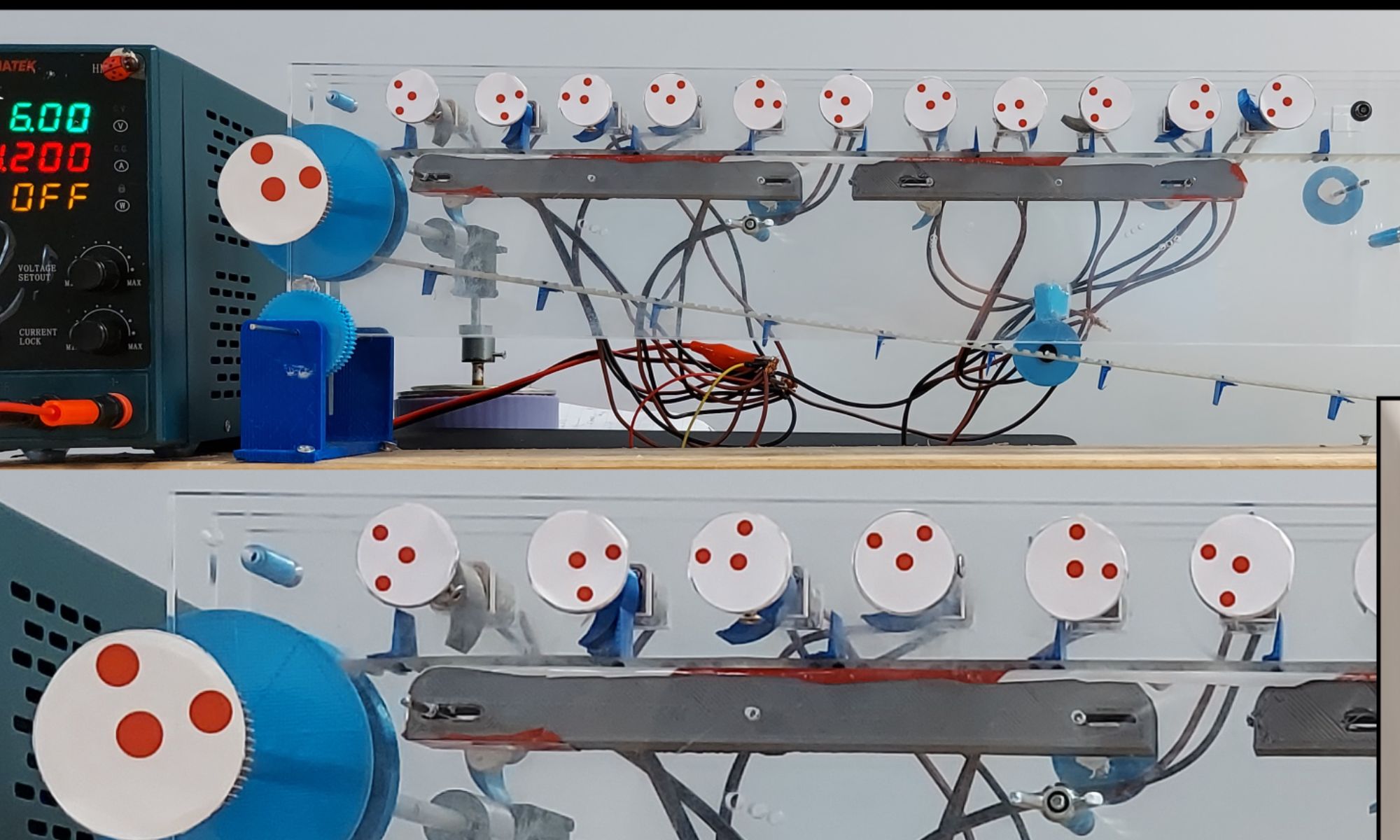
Mechanical motors created to mimic molecules that enable human muscles to contract could eventually offer new insight into ageing and conditions including muscular dystrophy, say scientists.
Researchers working at the University of Bristol Polymaths and Soft-Robotics labs hope their work could also create new opportunities to improve artificial muscles used for robotics.
Writing in the Journal of the Royal Society Interface they explained how they replicated the features of the body’s actomyosin molecular motors using basic mechanical motors.
Their experimental model arranged electric motors to resemble muscle proteins in an actomyosin-like configuration, used along with 3D-printed plastic components and laser-cut acrylic.
The thousands of molecular motors in the human body act in coordinated fashion with muscles tackling increasing loads able to increase the number of biochemical motors they call upon.
The lab-made device similarly ‘self-organised’ into coordinated travelling waves of motion that automatically adapted as mechanical load increased, said the researchers.
“The motors aren’t ‘talking’ to each other directly. Each one pushes on a shared backbone structure, which changes what the others feel,” explained study team leader, senior lecturer in applied mathematics and data modelling Dr Hermes Bloomfield-Gadelha.
“Over time, that feedback causes them to fall into coordinated patterns on their own – a bit like rowers synchronising their strokes or the classic synchronisation seen in pendulum clocks.”
While the work raised possibilities in terms of engineering robotic arms and systems that adapted automatically, it also offered new biological perspectives, he said.
“It … raises questions about how much of muscle behaviour depends on motor chemistry and how much comes from the organisation of the system. Understanding that balance could help us better understand muscle health, disease, ageing and conditions such as muscular dystrophy."
The project was developed by Dr Benjamin Warrington for his doctoral research with Dr Gadelha and professor Jonathan Rossiter surpervising the physical build and mathematical modelling.
