
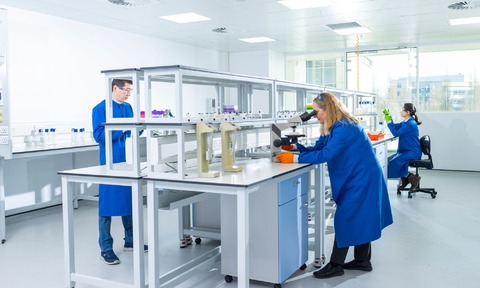
Conversion is an attractive alternative to new lab builds, says Todd Payne, but coherent design, reduced energy, full compliance and access for all are prerequisites.
With world-class universities, research institutes and a mature pharmaceutical ecosystem, the UK is an attractive place to invest in laboratory space. And now, with the government also pumping billions of pounds into the sector as part of its Science and Technology Superpower agenda, demand for these spaces is growing rapidly.
It has led to a boom in new lab builds, refurbishments and conversion projects. The latter two options are proving popular with companies looking to move fast, keep costs down, or make use of their existing property estate.
While there are significant benefits to refurbishing older buildings or converting office space, they often come with complications that are not trivial. If projects are not planned properly, this can add hundreds of thousands of pounds in energy costs alone. To address those concerns, let us examine the main factors to consider and how they can be managed.
Holistic design planning
Whether laboratories are being created for R&D or for teaching chemistry or biology, these environments all need appropriate safety equipment installed. A chemical laboratory, for example, will need fume cupboards that draw air out of the laboratory through an exhaust system. This prevents users from inhaling vapours, gasses and particulates. Biological or pharmaceutical laboratories will also need safety cabinets to contain biological hazards, protect samples or safeguard products.
When companies select these and other forms of containment furniture, they will be looking at the specific risk profile and workflow requirements. In addition to this, however, they will also need to create a coherent ventilation strategy that balances safety with energy efficiency, ergonomic requirements and regulatory compliance.
It can cost a significant amount of energy to control temperature and humidity in a laboratory. When refurbishing older buildings, these air conditioning demands can be even greater.
So, if you then have safety equipment sucking thousands of cubic metres of air out of the building each hour, it can become an energy-intensive and expensive operation.
Reducing energy consumption
As a result, we are seeing companies shift to containment furniture with variable air volume (VAV) airflow control systems rather than constant air volume (CAV). VAV control systems can reduce airflow to match real-time demand.
For example, these units include a variable damper, situated on the top of the fume cupboard, which monitors the required extract volume based on where the operator positions the sash.
When the sash is closed, this triggers a reduction in extracted air to a minimal level and can reduce the amount of air being exhausted by up to 80%.
While there are significant benefits to refurbishing older buildings or converting office space, they often come with complications that are not trivial. If projects are not planned properly, this can add hundreds of thousands of pounds in energy costs alone
With most large companies, the NHS and universities all making commitments to reach net zero, this will have a major impact on CO2 emissions – and save them a huge amount of money in the process.
For example, the University of East Anglia recently completed the refurbishment of its iconic Grade II-listed structure, the Lasdun Wall. This included four floors dedicated to laboratory and teaching facilities and encompassed the installation of more than 100 fume cupboards.
The deployment of VAV-controlled units is likely to save the university hundreds of thousands of pounds a year in air conditioning costs.
Meeting compliance standards
Most modern laboratories also need to factor in the need to meet several compliance requirements. Part five of the BS EN 14175 standards, for example, provides specific guidance on the positioning of fume cupboards – how close equipment can be placed to each other, the distances they need to be from doors, windows, walkways, and more.
These requirements can create a challenge for companies looking to procure and install standard-sized equipment.
This becomes especially relevant within a refurb or conversion project, where there may be restrictions due to structural pillars, ceiling heights, etc.
When it comes to critical safety equipment, companies need to be pragmatic in their designs. This usually results in the commissioning of bespoke unit sizes to ensure they fit the available space while still meeting stringent performance standards.
Providing accessible workstations
In addition to the positioning and performance of units, companies also need to think about end-user accessibility.
Many organisations will require units that are compliant with the Disability Discrimination Act (DDA), for instance.
When we think about accessibility, however, it is worth considering the needs of all users and their individual spatial requirements. Ergonomic design is crucial.
This will ensure safety units are suitable for operators who are seated in a wheelchair or standing over 6ft 7in.
The traditional approach to improving accessibility has tended to focus on providing worktops with adjustable height controls.
If you have safety equipment sucking thousands of cubic metres of air out of the building each hour, it can become an energy-intensive and expensive operation
However, this has never been satisfactory as it does not provide full access to the whole unit. Instead, we are now moving towards hydraulic rams that allow the entire unit to be eight adjustable.
If companies want to ensure their new laboratory spaces operate as efficiently as possible, it is worth considering how they will be used when fully functional.
This will help businesses select the right safety units and deploy this containment furniture in the best possible way – ensuring users perform at the highest possible level, remain safe from harm and organisations keep their energy usage and costs down to a minimum.
Todd Payne is commercial manager at Envair Technology
