
DESI calls time on mapping universe and 47 mill galaxies
19 Apr 2026
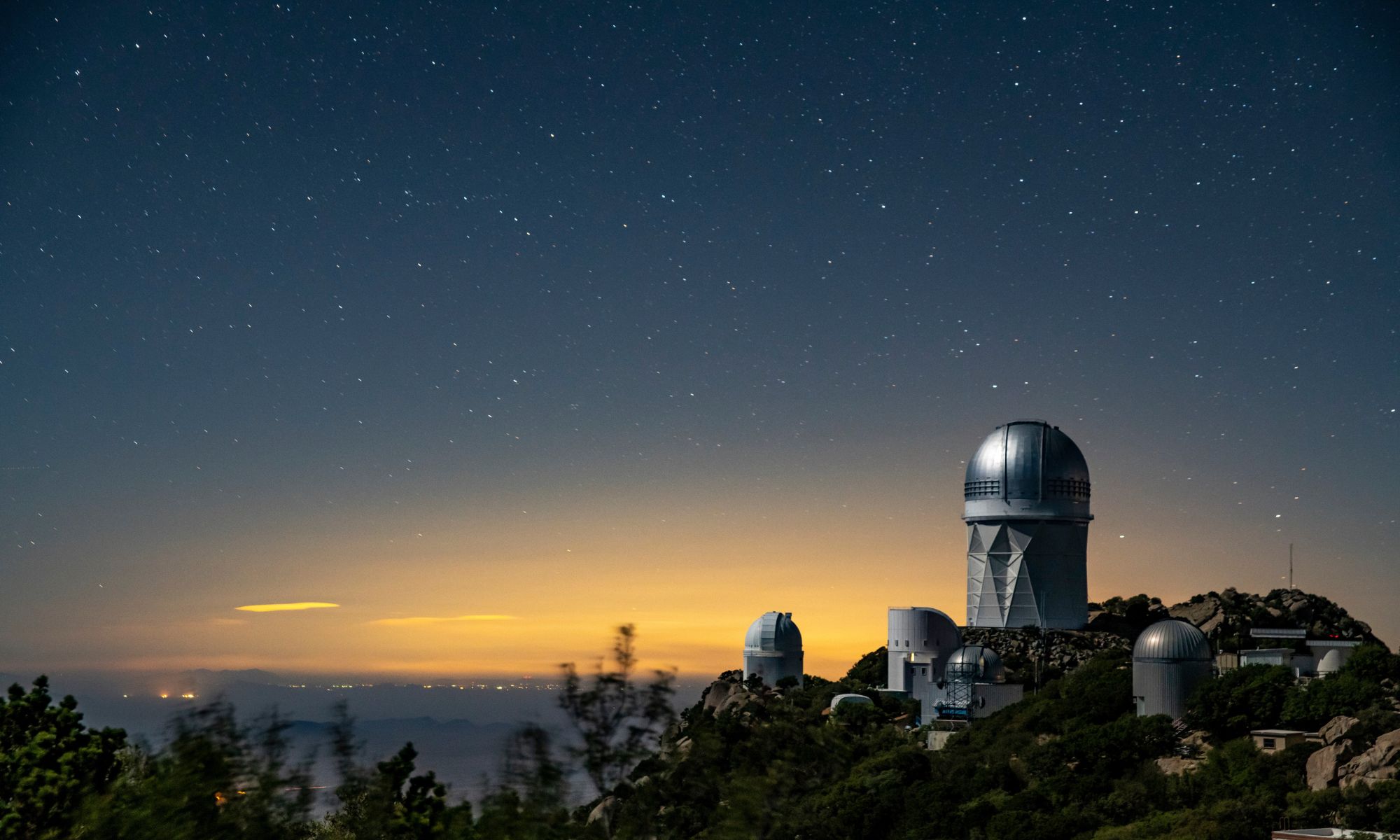
One of the greatest cosmological surveys ever staged has finished its five year project to produce the most comprehensive 3D map of the universe so far achieved.
The Dark Energy Spectroscopic Instrument (DESI) survey employed more than 900 researchers, one third of them PhD students, from 70 institutions worldwide.
It has observed in excess of 47 million galaxies and quasars– substantially more than its original 34 million goal and measured data six times greater than all previous measurements combined, says project participant the University of St Andrews.
Information collected has enabled the participants led by the University of California Berkeley to investigate the role played by dark energy in the universe over 11 billion years.
Results analysed from the first three years of data alone revealed unexpected possibilities about the nature of dark energy, suggesting that it possibly evolved over time and contradicting previous assumptions that it formed a ‘cosmological constant’.
Professor of astronomy at St Andrews Rita Tojeiro, who has been involved in the project for over a decade, said that DESAI’s 3D map was enabling “world-class legacy science”.
“Each of the 47 million galaxies and quasars that DESI observed tells a unique story. We can collect these individual stories to reveal the overarching narratives of how galaxies form and evolve through cosmic time,” said Tojeiro.
“Because DESI is revealing the three-dimensional cosmic web in which galaxies live with unprecedented detail, we can now study how galaxies respond to cosmic structures around them in ways that have not been possible before.”
DESI’s work will continue for a further two years, to enable refinements of its observations on more distant and fainter galaxies, plus nearby dwarf galaxies and stellar streams of stars pulled from smaller galaxies by the gravity of the Milky Way
Professor Carlos Frenk, Ogden Professor of Fundamental Physics at the Institute for Computational Cosmology, Durham University, is a member of DESI’s institutional board.
He acknowledged that, a decade previously, the thought of being able to measure the rate at which the Universe expands with an accuracy of 1% resembled fantass.
“The amount and quality of the DESI data and the analysis carried out by an international team of very talented scientists is behind this achievement,” he stated.
“The rewards are huge: the data suggest an unexpected behaviour of the dark energy that may upturn the currently accepted view of how our universe evolves.”
Pic: Mayall Telescope Kitt Peak National Observatory near Tucson, Arizona. Phtographer Marilyn Sargent, © The Regents of the University of California, Lawrence Berkeley National Laboratory
