
Powering the lab
8 Dec 2025
When a technology increases in sophistication, automation and ease of use, so can the results. In the case of electron microscopy, gains in the laboratory have been considerable, explain Anna Prokhodtseva and Tim Booth.




Scientists depend on having the right tools in their labs to advance scientific breakthroughs that push society forward. Whether their research focuses on proteins that drive disease or novel materials used to advance alternative energy, electronics and industrial sectors, accessible technologies that can drive deeper insights are essential.
Electron microscopy, a technique that has long propelled discovery across disciplines, once demanded years of specialised training and required infrastructure often only afforded by large, specialty facilities. But, today, there are cutting-edge microscopes that utilise automation, offer simplified workflows and expand remote access, which is changing the landscape for modern scientists and making this technology more accessible for any lab.
Equalising the variables with automation and simplified workflows
Advanced imaging technology offers new avenues for discovery, helping uncover the previously unseen. The latest electron microscopes, combined with smarter software and automation, help scientists access precise, nanoscale imaging and generate high-quality reproducible results, regardless of their skill level.
Features such as automation of critical imaging functions, step-by-step guided workflows and saved user profiles help scientists spend less time on routine tasks and more time on conducting experiments that further their research. These tools welcome new users and give highly experienced scientists the opportunity to push boundaries with their work.
Artificial intelligence also plays a key role in the lab. With AI-driven segmentation, reconstruction and analysis, scientists can holistically accelerate imaging workflows for advanced 3D characterisation at the nanometer scale. AI can help scientists spot patterns and make decisions faster, which alleviates some of the data burden that electronic microscopists have long balanced. With these technological innovations, labs are able to process more samples and find answers to their most pressing questions faster. Whether they are studying images of cells or tissues or characterising materials, labs across industry and academia can achieve consistently high-quality results.
Remote access and technical support makes everything from training and onboarding to running long experiments simpler.
Teams can work together, regardless of physical location, to acquire data and give feedback much faster than before. This saves scientists from downtime and lab managers from travel expenses. As operations grow, labs can tap into global expertise, making it significantly easier to search for answers and drive new discoveries.
Expanding access to next-generation instrumentation
Exceptional performance and user-friendliness are only two pieces of the picture. Instruments built to support modern scientists with a diverse range of scientific imaging and experimentation needs must be accessible for labs of all sizes. Innovative transmission electron microscopes (TEMs) and focused ion beam scanning electron microscopes (FIB-SEMs) can bring industry leading performance to more researchers in core labs and imaging facilities. These tools can also be used to conduct advanced research in diverse environments across the scientific and industrial landscape.
While life scientists have long trusted TEMs for performance, features of cutting-edge tools such as a widened sample loading area and transfer deck, and light animations that direct users when loading samples make user interactions seamless.
In materials science, advanced imaging enables the study of new and complex materials down to the nanometer scale
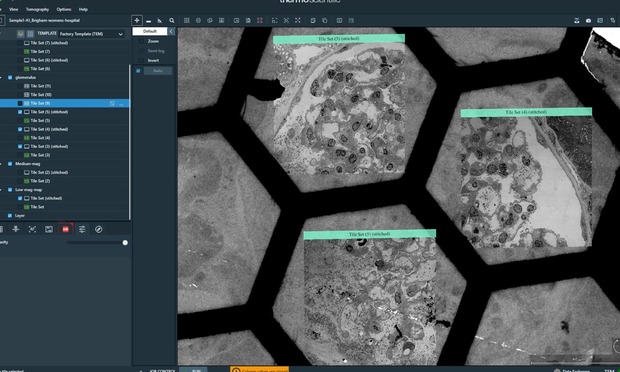
With fully integrated and embedded cameras, scientists can quickly get the high-contrast visualisation they need to scan and find areas of interest. When combined with the latest software, they can intuitively navigate their sample and adjust magnification as needed to capture specific structures.
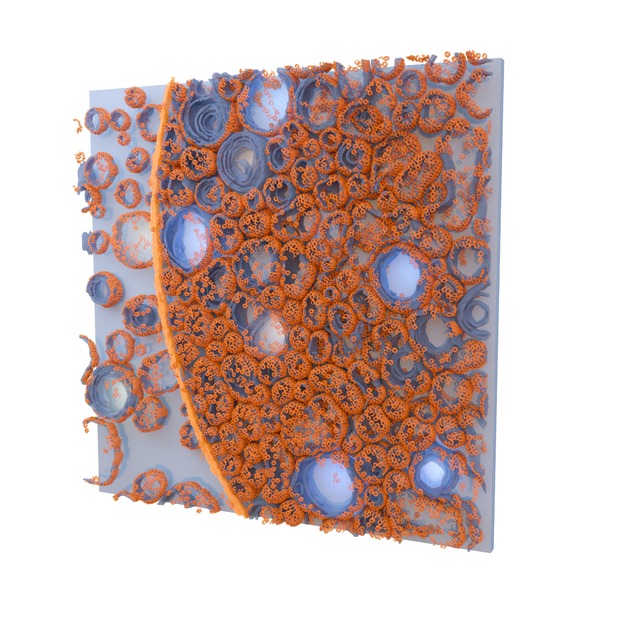
Whether scientists are studying cells and tissues for pathology or conducting structur al biology research, modern TEMs can be a powerful tool. In fact, researchers at the Paul Ehrlich Institute used a TEM to capture ultrastructural cellular imaging of Ebolainfected [1] cells to discover how the virus replicates. Another team from the University of Muenster uncovered the architecture of complex neurotoxins [2] using structural biology techniques with a TEM.
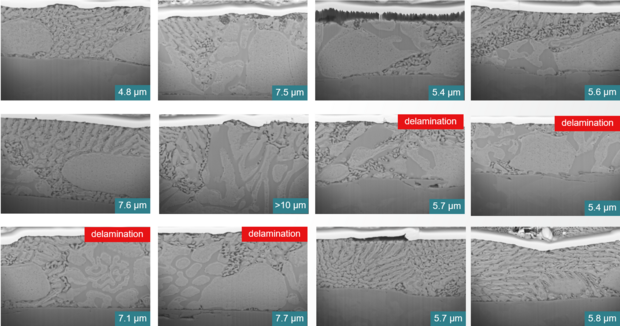
For materials scientists who need high throughput performance, ultra-highresolution FIB-SEMs excel in delivering sample preparation and three-dimensional characterisation for a wide range of samples – from magnetic to non-conductive materials. Advanced features like automated cross-section preparation and analysis give researchers powerful insights into subsurface structure of materials. This enables them to make informed decisions when developing novel materials or during quality control when they need fast, accurate and reproducible results. With modern FIB-SEMs, scientists can boost productivity in even the most advanced applications.
Sharper images, bolder breakthroughs
Expanding access to advanced imaging tools is opening new doors for scientists and industries alike. As providers of analytical instruments continue to innovate, tools that once called for years of training and robust infrastructure now feature userfriendly controls, automation and compact footprints. These major changes mean that more scientists, no matter their expertise or affiliation, can take on high-level, industrymoving research.
The impact can be profound. For example, when life scientists can see the inner workings of cells, viruses and proteins, they can better understand diseases and use this insight to develop more targeted treatments.
Instruments built to support modern scientists with a diverse range of scientific imaging and experimentation needs must be accessible for labs of all sizes
With automated imaging and AI-enhanced analysis, life science organisations can find promising drug candidates much faster, which means that drug makers can cut the time it takes to get life-changing therapies to patients. In materials science, advanced imaging enables the study of new and complex materials down to the nanometer scale.
This reveals critical information about novel materials, such as structural properties, composition and failure mechanisms. When engineers are seeking better materials for digital devices or batteries, they rely on this information to ensure that the material they choose is safe and effective.
Broader access to advanced analytical technologies has a significant impact felt beyond science and engineering. It means that answers to society’s most pressing questions, from fighting chronic diseases to developing cleaner energy solutions, can be found faster than ever before. More widespread use of these tools helps science have a real, positive impact on our world, making it healthier, cleaner and safer.
References:
1 https://www.cell.com/cell/ fulltext/S0092-8674(24)01340-0
2 https://www.nature.com/articles/s41467-024-52635-5
Anna Prokhodtseva is product manager, DualBeam, Thermo Fisher Scientific
Tim Booth is product manager, Thermo Fisher Scientific
