
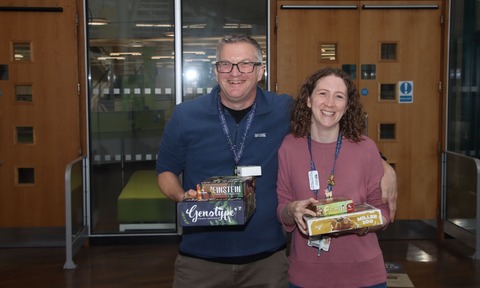
Celebrating Game Theory’s 40th appearance, Ian Turner and Louise Robinson venture out from page 47 to discuss the lighter side of STEM.
University of Derby colleagues, senior lecturer in forensic biology Dr Louise Robinson and professor in learning and teaching Dr Ian Turner have been regular fixtures in Laboratory News for several years, rooting out entertainment with a scientific slant and assessing them for accuracy, educational value and fun. What better time to interview them then, than during the peak board game season…
Forty columns – did you imagine at the start that Game Theory would run this long?
We’re delighted to have created 40 columns and that Lab News has been happy to hand over their last page to us for that long. As the years have passed, more and more scientific based games have been hitting the market which is brilliant whichever way you look at it.
How did the idea of reviewing sciencethemed board games first come about?
Well, we both really love playing games and were looking for a good excuse to play them at work! In all seriousness, we really feel that games have enormous potential to assist people with a wide range of skills and even enhance their scientific knowledge and we wanted to share this passion.
What makes a game scientifically strong in your eyes — accuracy, creativity, teachability, or something else?
It is really hard to make a game with 100% scientific accuracy as sometimes a bit of creative licence is necessary to make it work. A game could be scientifically strong but that could drastically impact on its creativity and fun factor – and who’s playing that game? Often, it’s the starting point for a conversation about something, i.e. you are playing a cloning themed game and can chat about the wonderful world of genetics while playing.
Do you ever find a game that’s so much fun, you forgive its scientific flaws?
Of course. As forensic scientists it’s no different than forgiving an excellent TV drama for unrealistic lab timelines. You appreciate the ones that manage to balance science and creativity, but by understanding what is flawed in a game, then you are still learning and applying knowledge. The primary purpose is entertainment, not education.
Have you noticed any trends over the years?
From casual observation there seems to have been a shift to a lot of conservation-based games which have taken many different approaches to the subject. There has been a worldwide boost in the popularity of games; we often think we have run out of games to review, then new ones pop on the mark etc.
Which title stands out as the best at turning real science into engaging play?
Rather than a single game we would like to flag the excellent Genius Games who have a primary focus to produce scientifically accurate games and jigsaws. We have reviewed many of these over the years and love the way they can turn fairly niche areas of science, e.g. protein synthesis, into an entertaining game. As they state on their website: “Everything we do at Genius Games is rooted in this mission... we hope to introduce the world of science to the next generation of innovators, scientists and engineers.”
How do you divide the work between you – do you play together, compare notes afterwards, or dispute the final score?
In the beginning we would always play test the games together but all that changed in 2020. Since then we have chosen games to take the lead on and shared our thoughts on the games we’ve reviewed. The great thing about games is we have involved our family and friends in helping us ‘test’ them!
Do you think board games have a genuine role to play in science education and do they have a future in the digital era?
Board games are a brilliant interface for scientific learning, often the theory being studied is not something which is easily visualised, so games which are able to do so are fantastic. We’re sure that the digital horizon of science-based games will change – especially those using platforms which may include AI interactions. We’re excited to see what the future will bring but table top games will always have a certain hold over us.
If you could design your own science-themed games, what would those be?
Funny you should say that; Louise designed a conservation-based board game years ago called Park Life [pictured above] which was used in our undergraduate teaching at the University of Derby. You had to build a protected reserve, generate genetically distinct breeding pairs, battle poachers and ensure you were gaining income to keep your park running. As for ideas, we have plenty. Maybe that’s an idea for a new column…
