
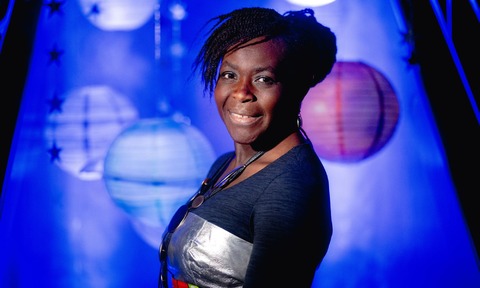
The Royal Institution Christmas Lectures mark two centuries of breaking barriers between science and the public. This year’s presenter, Dame Maggie Aderin-Pocock, will focus on endeavours to overcome the boundaries between our world and what lies beyond…
Your theme of course is Space. What first drew you to the subject?
Space has fascinated me for as long as I can remember. In a way, it’s the biggest subject you can possibly choose, because it’s literally everything beyond Earth – the ultimate playground for curiosity.
Chronologically, it started with the Moon landings. I’d hear about astronauts walking on the Moon, then look up at that bright disc in the sky and think: “Wow, someone has actually been there.”
For a child, that was mind-blowing. Growing up in London, with all its light pollution, the Moon was the one celestial body that really stood out.
But it was my father who really nurtured that fascination. He’d tell me stories of growing up in Nigeria, cycling along unlit roads across the savannah with the Moon lighting his way. He’d say the Moon was his friend. I’ve always been an insomniac, and as a child when everyone else was asleep and the house felt a bit spooky in the dark, I’d pull back the curtain and let the moonlight in. It felt like I had a friend too.
What does it mean to you to be delivering the Christmas Lectures as the first Black woman to do so?
It’s an extraordinary honour, and I’m incredibly proud. For a science communicator, the Christmas Lectures are a bit of a pinnacle. I’m a space scientist, but I’m also deeply passionate about education and sharing science with young people, so being asked to give these Lectures feels very special. Being the first Black woman to deliver them does bring an extra layer of responsibility especially in this 200th anniversary year. I want them to be joyful, inspiring and unforgettable. I also love the history. Michael Faraday, who started the Lectures, came from very humble beginnings and rose to become one of the great scientists of his age, at a time when science was dominated by the privileged. So baked into the DNA of the Lectures is this idea of breaking barriers and opening doors. I like to think that, in my own way, I’m continuing that tradition – and that as time goes on, the Lectures keep becoming more inclusive and representative of the world we live in.
Did you grow up watching the Lectures, and if so, did anything stand out for you?
Yes, I did. They were real appointment television in our house. The series that stands out most for me is Carl Sagan’s. After his Christmas Lectures he went on to make the TV series Cosmos, which had a huge impact on me as a child.
I have a vivid memory of him describing a supernova – a star exploding – and watching on our little black-and-white television as the screen. The whole room full with light. I remember thinking: “I want to see one of those!” That combination of big ideas and beautiful storytelling was one of my main portals into space. The Lectures, and Sagan in particular, helped show me that the universe is not just ‘out there’ – it’s something we can all connect with.
Why do the Lectures matter in an era of so much digital (including scientific) content?
When I tell people I’m doing the CHRISTMAS LECTURES, there’s this wonderful buzz of excitement. I think that’s because, even in a world of endless digital content, there’s still something special about a live event where you see real people doing real experiments right in front of you.
The Lectures are famous for their big demonstrations, of course, but it’s not just spectacle. The demos are woven into a narrative that lets you explore the science behind them. They bring abstract ideas to life. One of the challenges in schools today is that there’s often less time and fewer resources for hands-on experiments. Yet, if you ask adults what they remember from their science lessons, it’s usually a moment when something fizzed, flashed or even exploded!
The Christmas Lectures lean into that: proper experiments, real curiosity, genuine surprise. They show that science isn’t just a set of facts on a screen – it’s a process, and it’s something you can do.
This era’s described as a transformational moment in planetary science. What recent technological advances and discoveries have most played a part?
We’re living through a really exciting time. Technologically, we’re seeing leaps in several areas at once, and together they’re transforming what we can do in space.
One big shift is human access to space. Only around 700 people in all of history have been to space, but whenever I ask an audience: “If a trip to orbit were as safe as a plane journey and about the price of a first class ticket to New York, would you go?” almost everyone says yes. We’re now seeing companies and agencies positioning themselves for that future. That raises fascinating questions about ethics, the environment and who gets to go, but it’s clearly a major driver of change.
At the same time, our robotic explorers and telescopes are becoming astonishingly capable. Probes like the James Webb Space Telescope (JWST) are letting us look deeper into space and further back in time than ever before. As someone who worked on JWST and other space instrumentation, it’s thrilling to see the community building these tools and then watching the universe reveal itself in more and more detail.
In a way, it’s the biggest subject you can possibly choose, because it’s literally everything beyond Earth – the ultimate playground for curiosity
And then there’s the role of the public. I love platforms like Zooniverse, which harness the combined brainpower of hundreds of thousands of people around the world. It’s like a kind of mass intelligence working alongside artificial intelligence.
Ordinary people have made discoveries and ended up as co-authors on scientific papers because of their contributions. That participatory element is a really important part of this new era too.
How has the James Webb Space Telescope already reshaped what we know about other worlds?
Webb is revolutionising our view of the universe across many areas of research, but if we focus on ‘other worlds’, its impact is already huge.
One of the most exciting things Webb can do is analyse the atmospheres of exoplanets – planets orbiting distant stars. By studying the light that passes through or is emitted by those atmospheres, we can work out their chemical fingerprints and ask questions like: is there water vapour? Are there gases we associate with life? Could this world be habitable, at least in the sense that it might support life as we know it?
We’ve now identified quite a few exoplanets that are a bit bigger than Earth – so-called ‘super-Earths’ – where Webb has seen water vapour in their atmospheres. Water is one of the key ingredients for life here on Earth, so that’s incredibly tantalising.
I once found myself discussing this with Sir David Attenborough over dinner – as you do! – and he said, very firmly: “Oh yes, you definitely need water for life.” And of course, that’s true for life on Earth.
But as a scientist, I have to keep a little part of my mind open to the possibility that somewhere out there, there might be life that plays by different rules.
That said, if we’re talking about planets that could be habitable for humans, or life as we currently understand it, then you do need liquid water, the right temperature range, the right distance from the star, and so on. With instruments like Webb, we’re now able to find exoplanets in this so-called habitable zone and start checking whether they tick those boxes. That’s an extraordinary step forward.
How do you see the role of UK researchers evolving in global space projects such as Webb, JUICE and others?
As Chancellor of the University of Leicester, I get a front row seat on the UK’s long and proud history in space research. Leicester, and many other universities across the UK, have been building instruments and flying missions for decades, often in partnership with NASA, ESA and other agencies.
What many people don’t realise is just how strong – and fast-growing – our space sector is in the UK. Space missions are usually too complex and expensive for one country to do alone, so collaboration is baked in. Over my career I’ve worked with NASA, the European Space Agency, the Japanese Space Agency, the Indian Space Agency and others. Together we build satellites to study everything from distant galaxies to our own planet.
A lot of my own work has been in Earth observation: using satellites to measure things like wind speeds in the atmosphere, track climate change, or monitor natural disasters. It’s a powerful reminder that space science isn’t just about far-off galaxies; it’s also about understanding and protecting our own world.
The Lectures, and Sagan in particular, helped show me that the universe is not just ‘out there’ – it’s something we can all connect with
And crucially, space technology is woven into everyday life in ways we barely notice. There’s a lovely video that points out that in the first hour after you wake up, you probably interact with dozens of satellites without realising it – from the precise time on your phone alarm, to weather forecasts, to GPS on your commute.
Looking ahead, the UK is entering a particularly interesting phase because we’re developing our own launch capability again, but this time on UK soil. In the 1960s we had rockets like Blue Streak and Black Arrow, and then that work was cancelled. Now we’re seeing new, smallerscale launch sites and rockets that will put small satellites into orbit from UK soil.
For the next generation of UK space scientists and engineers, that means you could have an idea for a satellite, design it, build it and launch it, all within the UK. That’s a really exciting prospect.
What kinds of technologies or missions might take planetary science to its next level?
Here are a few directions I’d highlight:
- Sample-return missions
Bringing back carefully selected samples from Mars, asteroids, comets and, one day, icy moons to study in detail in Earth-based laboratories.
- Exploring ocean worlds
Missions to Europa, Enceladus and other icy moons, including landers or probes that can investigate their subsurface oceans and search for signs of life.
- Next-generation landers, rovers and drones
More agile robots – including flying drones on worlds like Mars and Titan – that can access challenging terrains such as cliffs, caves and polar regions.
- High-resolution ‘exoplanet imagers’
Space telescopes with advanced coronagraphs or starshades that can directly image Earth-like planets around nearby stars and study their atmospheres.
- In-situ resource utilisation and off-world bases
Technologies that let us use local materials (on the Moon or Mars) to build habitats and observatories, enabling long-term, on-thespot planetary science.
Traditionally, space exploration was reserved for scientists and Cold War one-upmanship. Tim Marshall (The Future of Geography) and others emphasise it’s now driven by more commercial, resource-driven and overtly geopolitical aims. Isn’t the unwelcome truth that this will enhance investment and support for space science?
I think it is true that commercial and geopolitical interests are now major drivers in space – and that they will bring in more investment. The big question is how we choose to use that investment.
Take the Moon, for example. Its gravity is about one-sixth of Earth’s, and we now know there’s water ice at the poles. You can split water into hydrogen and oxygen, which are the ingredients for rocket fuel. So, the Moon starts to look like a very useful “service station” for missions going deeper into the solar system. On top of that, there’s talk of mining helium-3 as a potential fuel for future fusion reactors. So yes, there are clear commercial opportunities.
The key, for me, is that we make space activity financially sustainable without repeating the mistakes we’ve made on Earth. We have to preserve the integrity of space, protect fragile environments and treat it as a shared resource. That means thinking carefully about regulation, environmental impact and fairness, so that the benefits of space – economic, scientific and inspirational – are felt as widely as possible.
So, I’d say: commercialisation will almost certainly increase the level of activity and investment, and that can turbo-charge science. But we must set the rules of the game wisely, so that we use space for the benefit of everyone on Earth, not just a privileged few.
How might AI or data analytics change the way we search for life elsewhere?
AI has a huge role to play. Telescopes like the James Webb Space Telescope are giving us an avalanche of data – far more than humans alone can process. Collecting the data is only half of the job; the real magic happens when you analyse it.
Right now, a lot of perfectly good data effectively sits on the virtual shelf because there simply aren’t enough people or hours in the day to comb through it all. With machine learning and AI, we can sift through these enormous datasets and pick out subtle patterns or anomalies that we might otherwise miss.
In the context of searching for life, that might mean spotting an unusual combination of gases in an exoplanet’s atmosphere, or a strange blip in a radio signal, or an unexpected feature in an image that looks like noise to us but stands out to an algorithm. It’s entirely possible that evidence of life elsewhere in the universe could be hiding in plain sight within data we’ve already gathered – and AI could be the tool that finally brings it to our attention.
You’ve referenced your own dyslexia. Has digitalisation and greater acceptance made it less of a barrier to entry into the profession?
I think it has helped, yes – though there’s still a long way to go. There’s much more awareness and acceptance of neurodiversity now than when I was growing up, and digital tools make a real difference: spell-checkers, text-to-speech, speech-to-text and so on.
But the thing that’s helped me most isn’t a gadget, it’s the collaborative nature of science. When people hear I’m a space scientist, they often say, “You must be so clever.” And I always think, well, I love the stars and I study them – but my spelling is atrocious! I can sometimes muddle words, my reading is slow, and it takes a lot of effort to write things. but that’s just part of being dyslexic. What I’ve also come to appreciate is that dyslexia comes with real strengths, strengths that organisations like Made By Dyslexia are highlighting. Dyslexic people are often naturally curious, good at seeing the big picture, strong communicators and very empathetic. Those traits are at the heart of what I do: asking “why?” and “what if?”, trying to put myself in my audience’s shoes, and telling the story of the universe in a way that feels welcoming rather than exclusive. Using tools like AI can be of real benefit to my works and strengths some of the areas I find hard.
Another facet of this is that organisations are realising that as individuals we don’t have to be good at everything. I’ve found a field I’m passionate about, and I work with people whose strengths complement mine. I bring my curiosity and my understanding of the physics; they might bring fantastic writing or organisational skills. Together, we can do things none of us could manage alone. We are bigger than the sum of our parts.
For me, that’s a powerful message for young people: everyone is clever at something. The trick is to find what our strengths are, and then build a team where our differences become part of the strength of the group, rather than a barrier.
- Dame Dr Maggie Aderin-Pocock will deliver the 200th anniversary series of the Christmas Lectures from the Royal Institution, to be broadcast on BBC Four and iPlayer in late December
